A Combat Buggy Armed With Anti-Tank Missiles Heads to the Marines
The United States Marine Corps has awarded a contract for the V2X Tempest, a lightweight tactical vehicle armed with AGM-114 Hellfire missiles that has already seen combat in Ukraine. The contract, valued at an initial $87 million with options for expansion, will equip Marine expeditionary units with a highly mobile, lethal strike platform capable of engaging armored vehicles, fortified positions, and small naval craft from a vehicle that can be transported inside a V-22 Osprey or slung beneath a CH-53K King Stallion helicopter.
The V2X Tempest represents a new category of military vehicle that blurs the line between a light reconnaissance platform and a precision strike system. Built on a modified high-performance off-road chassis, the vehicle weighs approximately 5,500 pounds fully loaded — less than a third of the weight of a Marine Light Armored Vehicle (LAV) — yet carries enough firepower to destroy a main battle tank at ranges exceeding five miles.
Design and Capabilities
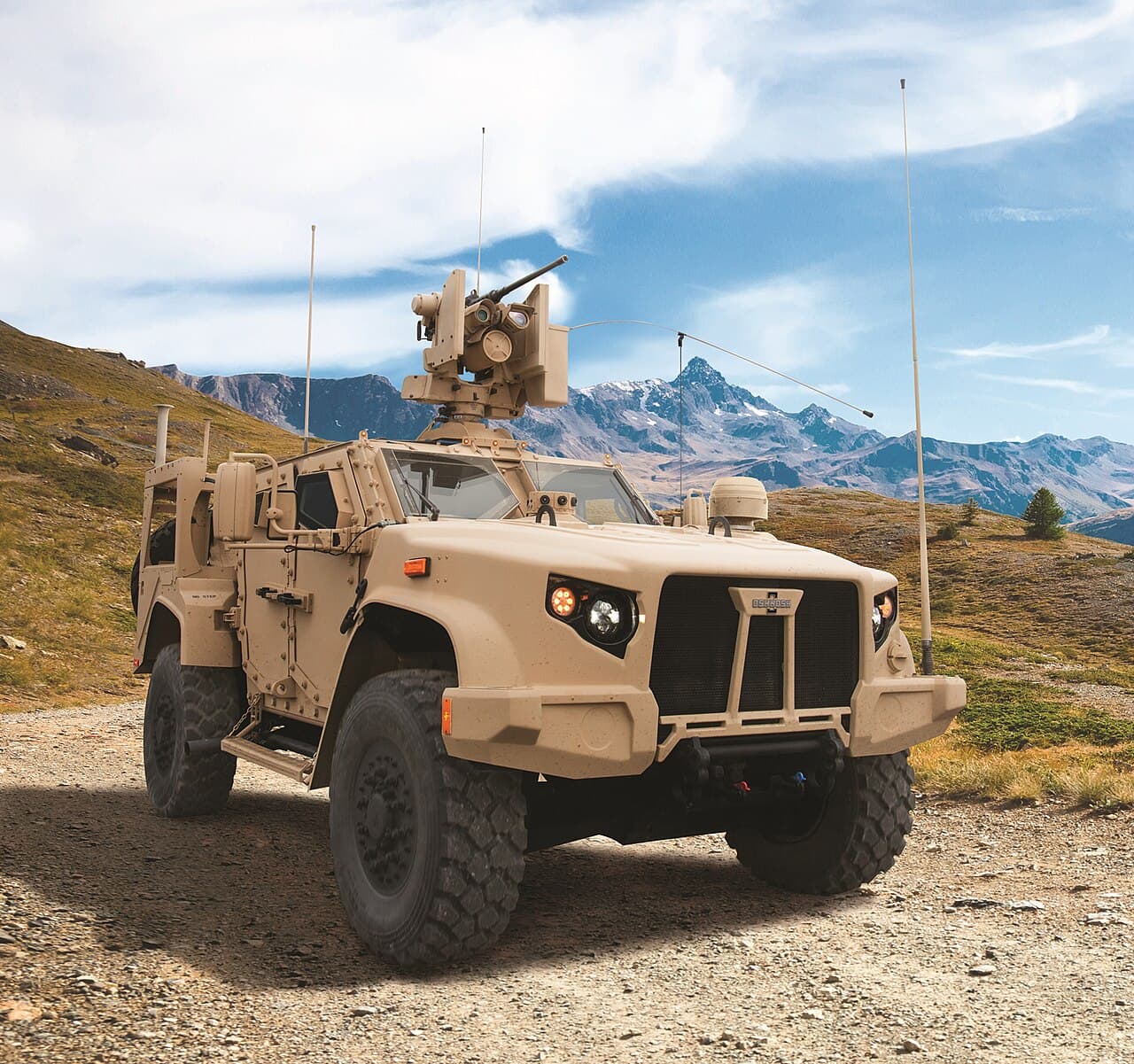
The Tempest's design philosophy prioritizes mobility, simplicity, and lethality over protection. The vehicle features an open-top configuration with a roll cage, a turbodiesel engine producing over 300 horsepower, and an independent suspension system derived from desert racing platforms. It can reach speeds exceeding 90 miles per hour on paved roads and maintains high mobility across sand, rocky terrain, and moderate gradients.
The weapons system consists of a roof-mounted launcher capable of carrying and firing up to four AGM-114 Hellfire missiles. The Hellfire, originally developed as a helicopter-launched anti-tank weapon, has evolved into a versatile precision munition available in multiple variants — including anti-armor, blast-fragmentation, and thermobaric warheads. The launcher is slaved to an electro-optical/infrared targeting system with a laser designator, allowing the crew to detect, identify, and engage targets at extended range.
Crew and Operations
The Tempest is operated by a crew of three: a driver, a commander/gunner, and a systems operator who manages communications and the targeting system. The vehicle's flat-panel displays and networked communications suite allow it to receive targeting data from external sources — drones, aircraft, forward observers, or other vehicles — enabling it to engage targets that the crew cannot directly observe. This networked approach is central to the Marine Corps' concept of distributed operations, in which small, dispersed units coordinate to deliver concentrated effects.
The vehicle also carries a secondary weapon station for a .50-caliber M2 machine gun or a Mk 19 automatic grenade launcher, providing self-defense capability against infantry and light vehicles. Smoke grenade launchers and a GPS-based navigation system with Blue Force Tracker integration round out the equipment package.
Combat Proven in Ukraine
What sets the V2X Tempest apart from other lightweight military vehicles is its combat record. A pre-production version of the vehicle was provided to Ukrainian forces through a combination of commercial sales and security assistance packages beginning in mid-2024. Ukrainian special operations units employed the vehicles in the southern and eastern theaters, using them to conduct rapid strike missions against Russian armored columns, logistics convoys, and command posts.
Reports from the Ukrainian battlefield indicate that the Tempest's combination of speed, low profile, and standoff precision engagement capability made it highly effective in the hit-and-run tactics favored by Ukrainian special forces. Operating in teams of two or three vehicles, crews would move rapidly to firing positions, launch Hellfire missiles at designated targets, and relocate before Russian counter-battery fire or drone surveillance could respond.
Lessons Learned
Ukrainian operators provided extensive feedback that influenced the production version selected by the Marine Corps. Key improvements include enhanced thermal management for the targeting system, which overheated during sustained operations in summer conditions; upgraded suspension components to handle the sustained high-speed off-road driving that Ukrainian crews demanded; and improved electromagnetic shielding for the electronics suite, which proved vulnerable to Russian electronic warfare systems.
The combat experience in Ukraine also validated the vehicle's operational concept. Ukrainian commanders reported that the Tempest's ability to deliver precision anti-armor firepower from a vehicle small enough to hide in a tree line or behind a building changed the dynamics of engagements that had previously been dominated by larger, more visible platforms like tanks and infantry fighting vehicles.
Marine Corps Concept of Employment
For the Marine Corps, the Tempest addresses a specific operational need within the service's Force Design 2030 restructuring. Under Force Design 2030, the Marine Corps has divested itself of tanks, reduced its artillery, and restructured to create smaller, more agile units capable of operating across the vast distances of the Pacific theater. These units need organic firepower that can be delivered by the aircraft the Marines already operate, without the logistical burden of heavy armored vehicles.
The Tempest fits this requirement precisely. A pair of V-22 Ospreys can deliver a section of three Tempest vehicles — carrying a total of twelve Hellfire missiles — to a remote island, coastal position, or inland objective in a matter of hours. Once on the ground, the vehicles can disperse, establish firing positions, and threaten enemy naval vessels, landing craft, or ground forces across a wide area.
Anti-Ship Capability
The Marine Corps is particularly interested in the Tempest's potential as a coastal defense platform. The Hellfire missile, in its Longbow variant, includes a millimeter-wave radar seeker that can autonomously acquire and engage moving targets — including small naval vessels. A network of Tempest vehicles positioned along a coastline could create a lethal zone for enemy landing craft or patrol boats, complementing the Navy-Marine Corps Naval Strike Missile batteries already being fielded.
Industrial and Procurement Implications
The Tempest contract is notable not just for the vehicle itself but for the procurement approach. V2X, the vehicle's manufacturer, is not one of the traditional large defense prime contractors. The company, which has roots in defense services and logistics, partnered with a motorsports engineering firm to develop the Tempest platform, leveraging commercial automotive technology and agile development practices to bring the vehicle from concept to combat deployment in under three years.
This timeline stands in stark contrast to traditional military vehicle programs, which routinely take a decade or more from requirement to fielding. The Marine Corps has cited the Tempest as a model for how the service intends to acquire equipment in the future: rapid development, early operational testing — including in combat — and iterative improvement based on real-world feedback.
Analysis: The Right Weapon for the Pacific Fight
The V2X Tempest's selection by the Marine Corps is a strong signal that the service is serious about its transformation for great-power competition in the Pacific. The vehicle embodies the principles of Force Design 2030 — lighter, faster, more distributed, and more lethal relative to its logistical footprint.
The combat validation in Ukraine is a significant advantage that no competitor could match. Real-world performance data, including reliability statistics, operational effectiveness, and crew feedback under fire, provides a level of confidence that no amount of testing range data can replicate. The Marines are not buying a prototype; they are buying a weapon that has already proven itself in the most demanding conditions possible.
Whether the Tempest will perform as well in the maritime environment of the Pacific as it has in the steppes of Ukraine remains to be seen. Saltwater corrosion, tropical heat, and the unique challenges of island operations will test the vehicle in new ways. But the foundation is sound, and the Marines' willingness to field a combat-proven system rather than wait for a perfect one reflects the urgency that the Pacific security environment demands.