Seeing the Whole Conversation
When a caterpillar chews a leaf or drought parches the soil, plants do not suffer in silence. Chemical alarms race through their tissues, coordinating defensive responses across organs that can be meters apart. Until now, scientists could only eavesdrop on fragments of this internal dialogue because conventional microscopes are too small to image an entire adult plant at once.
A collaboration between the Universita degli Studi di Milano and Politecnico di Milano has changed that. Their new imaging platform, MAPPI (MAcro Plant Projection Imaging), can visualize stress signals in leaves, stems, and roots simultaneously and in real time. The work, published in Science Advances, reveals a communication network far more complex than researchers had assumed.
How MAPPI Works
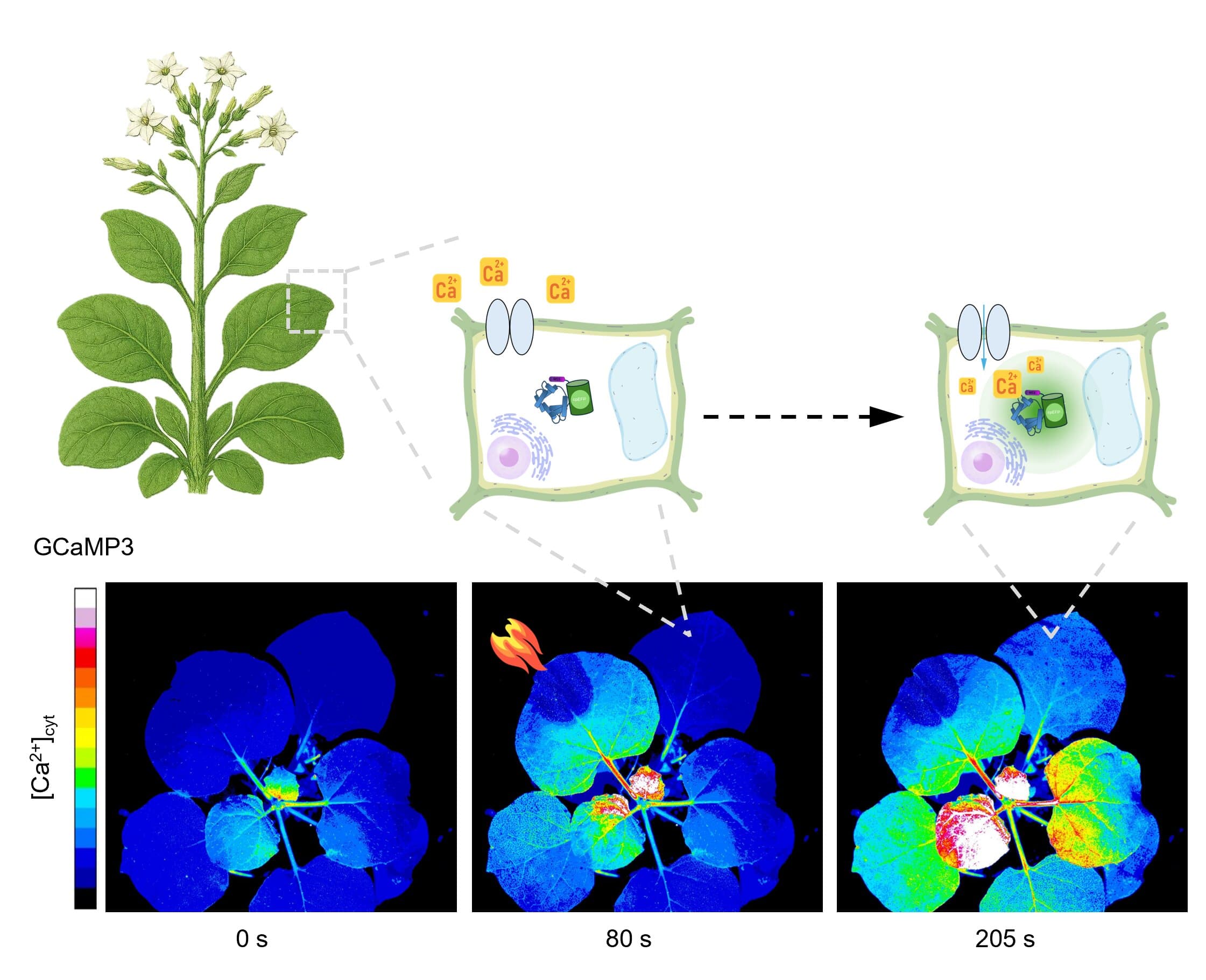
Lead researcher Alex Costa, a plant physiologist at the University of Milan, describes MAPPI as a macro-scale fluorescence microscope with a twist. The system uses perpendicular double vision, two camera angles that capture different parts of the plant at the same time, while fluorescent biosensors engineered into the plant report the concentration of signaling molecules.
The platform tracks two key messengers: calcium ions, which spike during rapid alarm responses, and glutamate, an amino acid that acts as a long-distance signal carrier much as it does in animal nervous systems. By watching both molecules move through the plant, MAPPI paints a dynamic picture of organ-to-organ communication that static snapshots could never reveal.
Crucially, MAPPI is modular, inexpensive, and open source. Study coordinator Andrea Bassi at Politecnico di Milano designed the hardware so that any lab with basic optics equipment can replicate it. The system accommodates plants approaching greenhouse size, removing the artificial constraint of working only with tiny seedlings under a conventional microscope.
Bidirectional Signals Upend Assumptions
One of the study's headline findings is that stress signals do not merely travel sideways between leaves, as earlier work suggested. The MAPPI data show calcium waves and glutamate surges moving bidirectionally between leaves and roots, meaning the root system actively participates in the conversation rather than passively receiving orders from above.
"We could observe signals running through the entire adult plant, dynamics we could only guess at until now," Costa explains. When a single leaf was wounded, calcium waves propagated downward through the stem into the roots within minutes, and secondary waves then traveled back up to distant, unwounded leaves. This feedback loop suggests that roots may modulate the defensive response in ways that have been invisible to science.
Glutamate as a Systemic Messenger
The role of glutamate proved especially revealing. In animals, glutamate is the brain's primary excitatory neurotransmitter. In plants, which lack a nervous system, it appears to serve an analogous long-range signaling function. The MAPPI footage shows glutamate accumulating at wound sites and then spreading through the vascular system ahead of the calcium wave, potentially priming distant tissues for the alarm signal to come.
Implications for Agriculture and Climate Resilience
Understanding how plants coordinate their stress responses is more than an academic exercise. As climate change intensifies droughts, heatwaves, and pest outbreaks, crop breeders need molecular targets to improve plant resilience. If the root-to-leaf feedback loop identified by MAPPI proves to be a bottleneck in stress tolerance, it could become a focus for genetic improvement.
The system also opens the door to high-throughput phenotyping. Because MAPPI can image large plants under near-natural conditions, researchers can screen hundreds of varieties for differences in signaling speed and intensity, identifying the fastest responders for breeding programs.
An Open-Source Future
The team has released full construction plans and software, inviting labs worldwide to build their own MAPPI rigs. Costa hopes the open-source approach will accelerate discoveries by letting plant scientists everywhere visualize signaling dynamics that were previously hidden. The next step is to adapt the platform for field-grown crops, bringing the laboratory closer to the greenhouse and, eventually, to the farm.