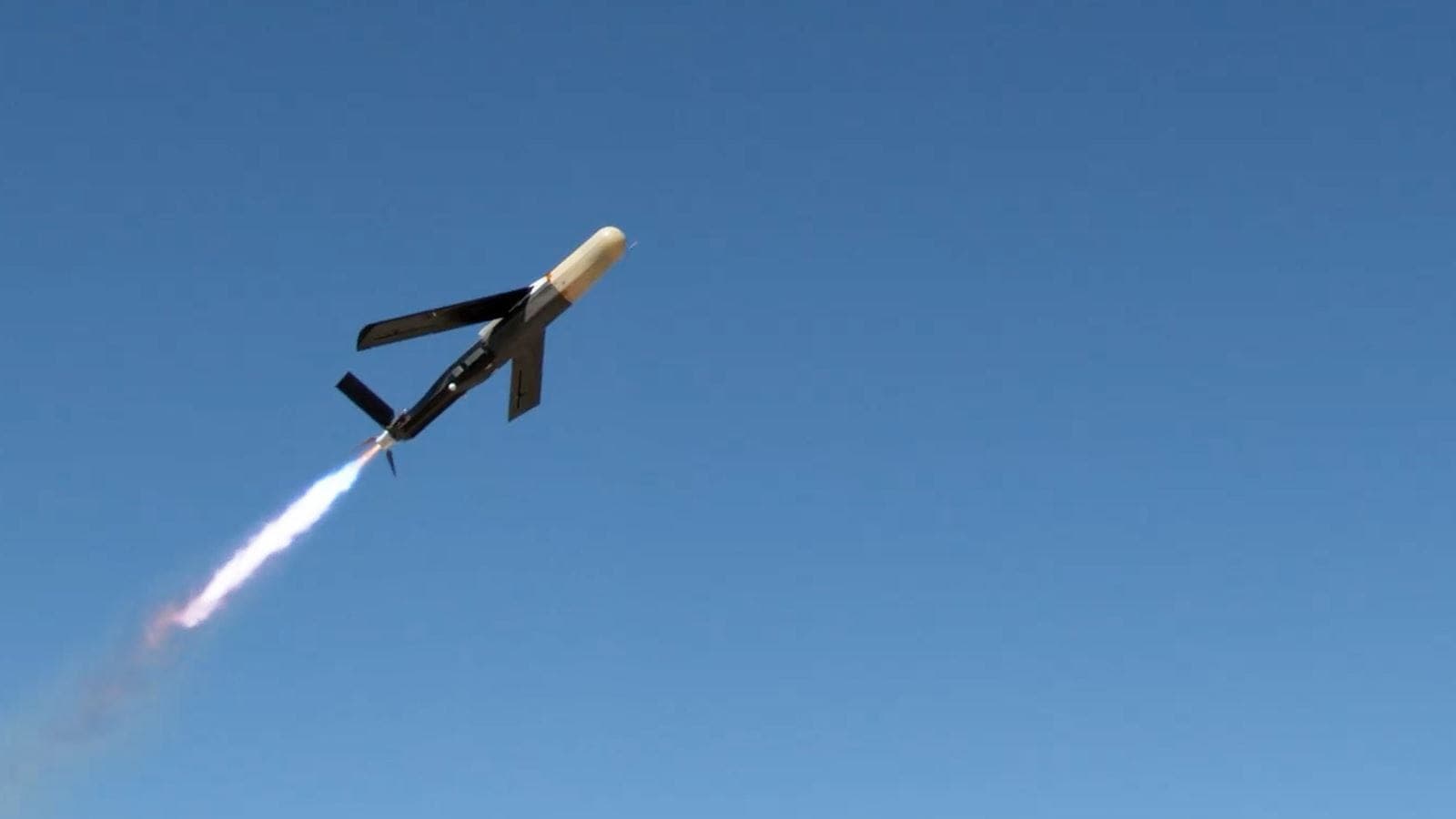
A New Kind of Anti-Drone Weapon
The modern battlefield has a drone problem, and it is getting worse. Cheap, commercially derived unmanned aircraft are flooding conflict zones from Ukraine to the Middle East, overwhelming traditional air defenses designed to engage far more expensive targets. Shooting down a $500 quadcopter with a $1 million missile is an unsustainable proposition. RTX's Raytheon division believes it has a better answer: a small, reusable interceptor drone that disables enemy swarms with an invisible burst of electromagnetic energy, then returns to base for another sortie.
During a recent U.S. Army evaluation at Yuma Proving Grounds in Arizona, the Coyote Block 3 Non-Kinetic (NK) variant demonstrated that capability in dramatic fashion. Operators launched the tube-fired drone against incoming swarms of Group 1 and Group 2 unmanned aircraft -- the small, tactical platforms most commonly encountered on today's battlefields -- and the Coyote dispatched them without firing a single explosive. The targets' circuits failed, their controls locked up, and they fell from the sky.
How the Coyote Block 3NK Works
The Coyote lineage stretches back through several iterations, each building on the last. The original Block 1 was an electrically powered reconnaissance platform with pop-out wings, designed for surveillance. Block 2 added a jet turbine engine and four control fins, along with a kinetic warhead that destroyed targets on impact -- effective but expendable. The Block 3NK retains the turbine performance of its predecessor but replaces the warhead with a non-kinetic energy payload, widely understood to be a high-power microwave (HPM) emitter or advanced electronic warfare suite, though the exact technology remains classified.
The electromagnetic burst fries the target drone's circuitry in a single pass, inducing high-voltage surges that disable flight controllers, communication links, and navigation systems simultaneously. Because the Coyote does not sacrifice its airframe in the engagement, it can loiter over an area, engage multiple threats in succession, and then be recalled for a net recovery and redeployment. That reusability is transformational for the cost calculus of counter-drone operations, where single-use interceptors can cost hundreds of thousands of dollars per engagement.
Networked Swarm Defense
The Block 3NK does not operate in isolation. It functions as a node within the Forward Area Air Defense Command and Control (FAAD C2) architecture, the U.S. Army's standard for coordinating short-range air defense assets. Multiple Coyotes can be networked together, autonomously allocating targets among themselves to handle saturation attacks where dozens of drones approach from different directions simultaneously. During the Yuma demonstration, the system validated its ability to track radar contacts, acquire target locks, and make engagement decisions under exactly those conditions.
"Coyote provides warfighters a cost-effective defense for individual drones and swarms," said Tom Laliberty, president of Land and Air Defense Systems at Raytheon.
Why It Matters
The Yuma tests come as the U.S. Army accelerates investment in counter-unmanned aircraft systems (C-UAS). Raytheon was recently awarded its largest-ever counter-drone contract as part of the Army's LIDS (Low, slow, small-unmanned aircraft Integrated Defeat System) program, which integrates radars, command-and-control software, and interceptors into a cohesive defensive package. The Coyote is the kinetic and now non-kinetic effector at the heart of that system.
The non-kinetic approach also addresses a critical concern that extends beyond the battlefield: collateral damage. Explosive interceptors raining shrapnel over populated areas or friendly positions create risks that electromagnetic effectors largely avoid. As drone threats increasingly appear in homeland defense and critical infrastructure protection scenarios -- from airports to power plants -- a reusable, non-explosive interceptor becomes an even more compelling option. The Coyote Block 3NK may be small, but it represents a significant shift in how militaries think about defending against the most pervasive aerial threat of the 2020s.